
After IndieCade was over, I had only one day in Chicago before I had to travel again, this time to Toronto for Gamercamp.
So, what is Gamercamp?
Gamercamp is an annual festival celebrating games that takes place in Toronto. It was started six years ago, and sadly, this year was its very last run.
Application
There was an online application to submit a game to Gamercamp, with a due date on September 2nd. I submitted the game, and was informed via email on September 15th. I remember the exact moment I read the message, because I was at the airport in Toronto, standing in line to board my flight to Tokyo for the Tokyo Game Show, when I got the news.
It was really uplifting for me to hear that Relativity had been selected, as only 5 days prior, I had gotten my rejection to IndieCade (see, don’t give up! you have to keep submitting).
Location
Gamercamp takes place at Hotel Ocho, a four-story hotel located in downtown Toronto.

Gamercamp actually rents out the entire hotel for the duration of the festival, as games are shown on every level.
Preparation / Sponsorship
Prior to Gamercamp started, the organizers sent out a manual to all the exhibitors. I was told that I would have a 4′ table to demo the game on, and large screen TV would be provided. From past shows, I know that having multiple computers works best for a game like Relativity. A lot of a local multiplayer games work best with a single TV, since you can have multiple people playing at the same time.
However, with a single player game, you can really only have one person playing at a time. On average, people seem to play the game for about 10 – 15 minutes at convention settings. I’ve noticed that when people have others waiting in line behind them, to start to get self-conscious, and will constantly be asking other people if they want to have a go. This usually happens before they’ve gotten to the good parts, and they haven’t gotten the best impression of the game they could have.
To avoid this, I decided I would have multiple computers at Gamercamp. From having shown at Indie MEGABOOTH back at PAX East, I knew that companies like Dell and Intel were often quite interested in providing sponsorship to indie developers.
I reached out to Alienware to ask if they were interested in sponsoring the show in Gamercamp by providing me with laptops. They were more than happy to do so, and after a discussion on the phone, they sent me a loaner request form. I filled this out, requesting two 14″ Alienware laptops, and they mailed them out to me. I did this while I was in LA for IndieCade, and the laptops arrived just in time in Chicago for me to bring them with me to Toronto.
I also reached out to some Toronto-based friends, to see if any of them could lend me a laptop for the duration of Gamercamp. A friend who works at interaction design studio Glabacore responded, and told me that the studio was able to lend me two 17″ Alienware laptops (these things are pretty sweet, but weigh a ton. They’re pretty much portable desktops).
Day 1 – Interactive & Games Conference
The first day of Gamercamp was Friday, October 17th. This was a conference format, different from the pop-up arcade, which took place on Saturday and Sunday. There was a small section showing games, but most of the main selections were not shown. It was geared towards industry people, and the day consisted primarily of talks on game development topics.
I arrived at Gamercamp just a little bit before lunch, and was able to catch a talk from PlayStation about what it’s like to work with them.
The way the talks were set up was there were two sessions simultaneously. One on the first floor and one on the second floor. The acoustics of the space weren’t so great for talks, as it was quite open, so the sounds between the two talks mixed a bit. However, it wasn’t too bad, and you could still hear the speaker.
Lunch was buffet-style and was provided as part of the event. 🙂
After lunch, I went to a talk by Kan Gao, the creator of To The Moon. I was quite excited about this because I had played To The Moon one afternoon several months ago. I had picked it up at some point via a bundle, and it sat in my Steam library untouched. I probably would not have played it, had it not been for recommendations from a few sources. Normally, I’m not a big fan of narrative-driven games, but a lot of the people played To The Moon found it incredibly moving, so I decided to give it a go.
Playing To The Moon gave me a lot to think about. Relativity is heavily mechanics driven, and most of the games I play are centered around a set of core mechanics. As a designer, I sort of subscribe to Jonathan Blow’s philosophy of games as an exploration of “truth” through the mechanic. However, To The Moon made me look at narrative-driven games in a new way. I won’t go into too much detail about it here, but I’ll just say that I really appreciated what the game did.
Anyway, Kan’s talk was titled “Making Use Of Advantages In Indie Game Creation”.
One part that really struck me was this quote Kan used in his talk:
“We do not choose between experiences; we choose between memories of experiences.
…
We do not think of our future[…]as experiences; we think the future as anticipated memories.”
– Daniel Kahneman
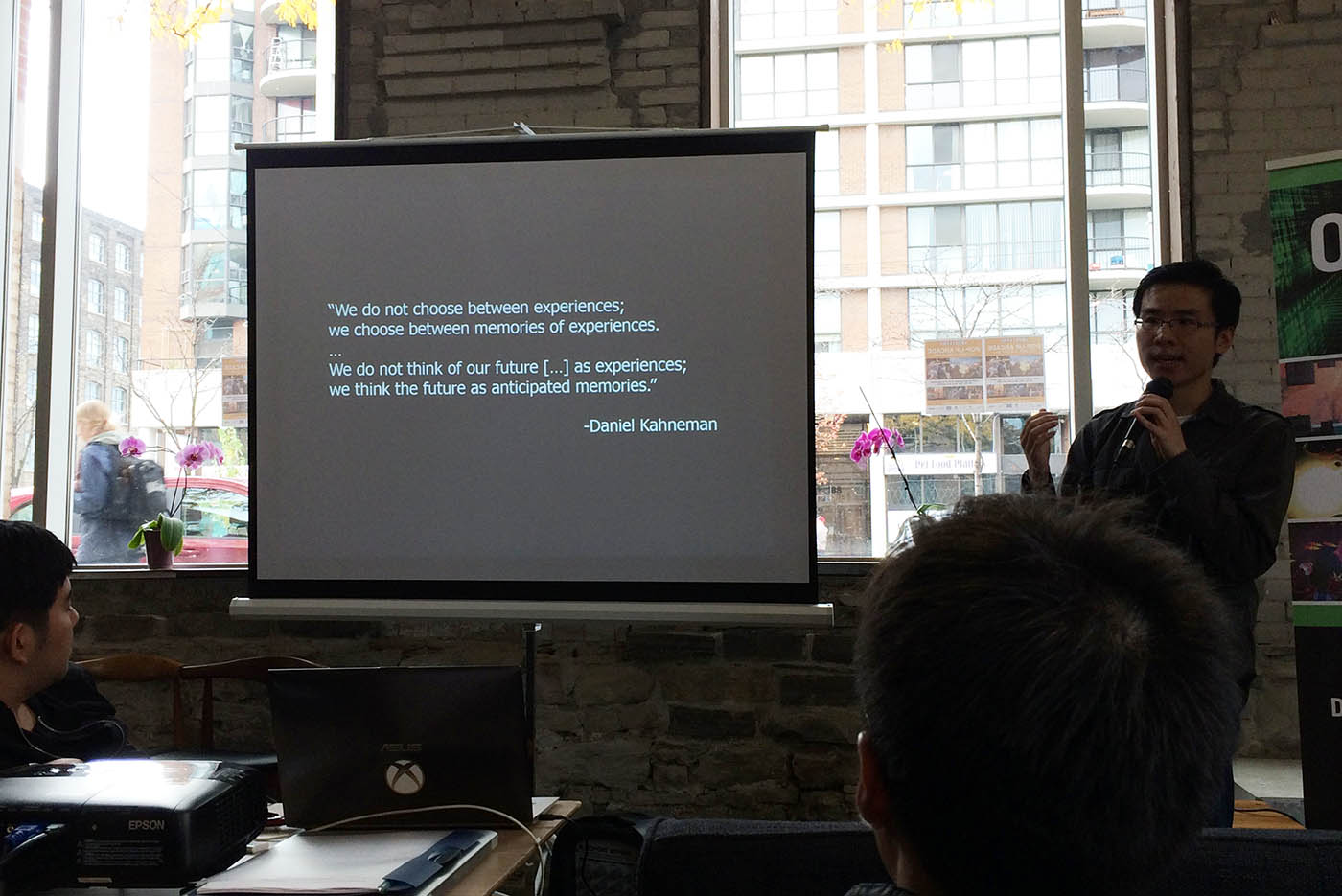
Unless you have photographic memory, you can’t remember an entire game from start to finish. It’s important when designing to think about what are the moments that leave an impression on people, because those are the moments that will stay with people, and those are the stuff that people will talk about when talking about your game. What kind of memories do I want Relativity to leave players with?
Kan’s talk ended a little earlier ahead of schedule, so I made my way upstairs, where Brie Code, the lead programmer on Child of Light at Ubisoft was speaking. Unfortunately I only got to catch the tail end of the Q&A session:

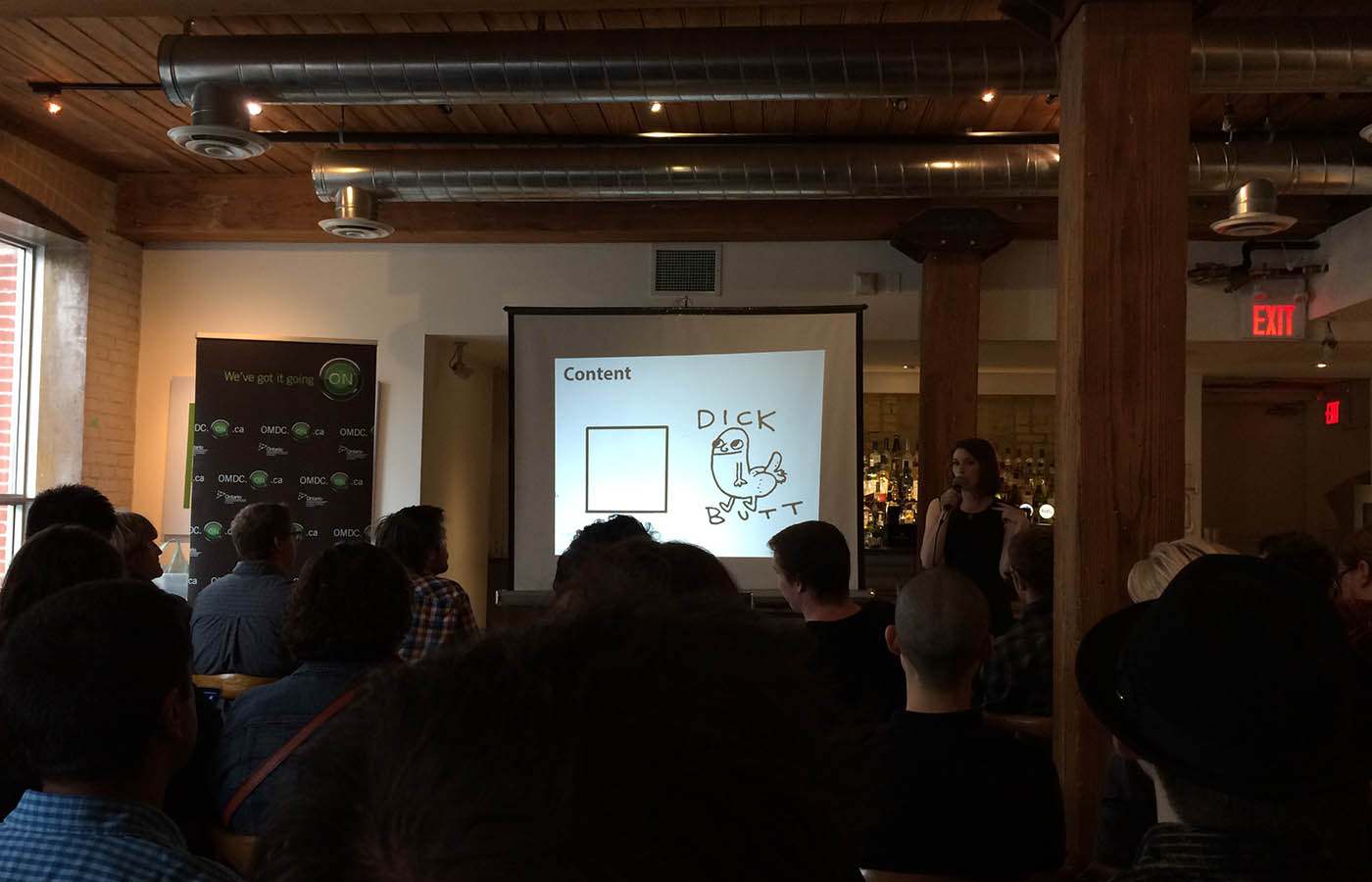
Later on, I went to a talk by Lyndsey Gallant of XMG Studio, titled “Simple Guidelines for Making Awesome Game Art”. It was a lot about creating visual hierarchy and how use colors, shapes, and contrast to guide the players.
This was a really funny slide about how content can be a way to attract player attention:
The conference ended at 5 PM. I went to dinner with a bunch of game developers who were at the conference. Afterwards, we returned to Gamercamp for the opening party, which started at 8 PM.
Gamercamp Opening Party
As it was the final Gamercamp this year, there was a surprise element at the opening party to honor Jamie Woo, one of the co-founders.
Here’s Jim McGinley, one of the founders of T.O. Jam (Toronto Game Jam) talking about the impact of Gamercamp on the Toronto game scene. 
Jaime himself also gave a brief speech, thanking everyone for being a part of Gamercamp.
It was definitely a very emotional moment for everyone in the room. Even though it was only my first time at Gamercamp, it had been around for six years. For some people, it was around for as long as they were involved with indie games in Toronto, so it felt very much like a pillar in the community.
It was a pretty amazing experience for me to be a part of.
Oh, and there was cake! 😀